Showing posts with label Rhode Island. Show all posts

Sunday, December 6, 2015

Leaf Lard + Stayman Winesaps = Iconic Apple Pie

-->


Trendsetter that I have always been, my beloved fat of choice for fruit pies is, at long last, making a comeback. It had gotten to the point where it was near-impossible to find even the commercial (hydrogenated) lard, and recipes that once called for lard—Mexican dishes and many old-fashioned baked goods—had been rewritten to call for Crisco or oil: for shame! But now, lard, like butter, is enjoying a resurgence as a natural food. People are actually making lard again! I have not yet found a local source—I am confident, or at least hopeful, that there is one—but carefully rendered pure leaf lard is increasingly available by mail order.   Thank you, sane and dedicated pig farmers.

Leaf lard is the exceptionally white and pure visceral fat from around the kidneys of the pig. A few words about lard, and leaf lard in particular, will, I hope, do its bit to help restore lard to its rightful place in cooking and baking. Lard was, of course, the most common fat in America before the development of stable oils, widely available commercial butter, and (don’t get me started) margarine. It was used just as one would use butter, not merely for baking or cooking but also to spread on bread (think lardo as served now as a special item in some Italian restaurants).  But lard’s decline in demand was not simply a matter of new, improved products replacing the old; its disappearance had as much to do with smear (no pun intended) campaigns as anything else.

This was ironic, given lard’s properties and characteristics versus many oils, butter, and margarine. For example, pure rendered lard has zero (that’s 0) transfats; it has a much higher percentage of “good” fat (monounsatured), and lower percent of saturated fat (the “bad”) than butter and the trendy coconut oil. It yields a flaky, rich pastry that has particular affinity, in my opinion, for pome and most drupe fruits, poultry and meats (as in empanadas or meat pies), and most berries. It is excellent for frying chicken and potatoes, and as a fat in old-fashioned cakes, cookies and breads, from biscuits and rolls to those containing fruits and nuts.  It adds depth without flavor; no, it doesn't taste like pig. And last but not least, lard, as an agricultural by-product of pigs that can be raised and produced locally, is sustainable and reflects a minimal-waste philosophy.

In time for the holiday baking, I had recently ordered my leaf lard (and some interesting smoked lard that makes very nice roasted potatoes) from FannieandFlo, when I spotted some Stayman Winessaps among the many apple varieties at the store. They were a local offering, unadorned by stickers or shine, priced 20 cents below any other variety. While everyone else grabbed their new-fangled Galas, I grabbed those. Along with Gravensteins and a few other old varieties, the Stayman Winesap is a fine baking apple.  With lard and good local apples in hand, there was only one thing to do: make a pie.


Classic Apple Pie with Lard Crust

You can make a butter and lard crust like this one, or, as I did for this pie, an all-lard crust.  Don’t put a lot of spices in your pie (especially clove or allspice); cinnamon, perhaps a touch of nutmeg if you  must, is all an apple pie needs.


Pastry for a double-crust 9” pie

2 ¼ c a-p flour
2/3 cup cold leaf lard
1 tea salt
6 T ice water


Filling
8 large apples (Cortlands, Macouns, or other crisp and tart-sweet baking apple can be used)
scant cup of sugar
cinnamon to taste
3 T a-p flour
pinch salt
1 T lemon juice
2 T unsalted butter

Make your crust in the usual way, by cutting the fat lightly into the flour and salt, then bringing it together with the cold water. Divide and chill, wrapped in plastic or wax paper. I prefer to make my pastry a day or more ahead (freeze it if you don’t plan to use it for a few days, then thaw in the refrigerator.

While the pastry is chilling, put the sugar, flour, cinnamon, and a pinch of salt into a a large bowl. Peel, core, and slice your apples about 1/4” thick, tossing them into the sugar mixture as you go. Add the lemon juice and toss. Always taste the juices before you fill your pie, adding additional cinnamon or a speck of salt if needed; you don’t want your pie to be over-spiced, but you don’t want it bland either.

Preheat the oven to 375F.

Roll out and fit the bottom crust into the pie plate; fill with the apples and pour in the juices. Dot the apples with the butter. Roll out the top crust and fit it over the apples. Trim the pastry as needed; turn it under to sit on the rim, and crimp. With a fork or small skewer, poke some holes into the crust to vent steam. If you have time, refrigerate the filled pie for 10 or 15 minutes.

Bake the pie in the middle of the oven for 45-60 minutes, or until it is golden, fragrant, and the juices begin to bubble through the vent holes. You can use a tiny bamboo skewer inserted into one of the vent holes to check that apples are cooked if you are not sure. Remove the pie and let cool completely before serving.

Saturday, August 23, 2014

Locovore: Loco for Local


No, not a typo. I recently had friends over for the last largish meal I made before leaving Rhode Island to return to my desert home for the academic year, and realized that, without even trying, every single thing we ate was locally produced. On an island (Conanicut, otherwise known as Jamestown).  Don’t you just love that? 

It was hot in the morning, and the forecast was for thunderstorms. My friends don’t care for the heat. And my cottage is little and, of course, doesn’t have air conditioning. So I decided to make a dinner that I could cook before the rain and serve at room temperature. What a great excuse: that’s actually one of my favorite ways to eat.

My friend Wayne (source of the mussels) had called me up and offered me some fresh-caught Bluefin tuna “head steaks”; I learned that this was the meat right behind the head that was cut off in preparing a giant tuna to be sold. My friends may not like the heat, but I knew they liked tuna, so of course I said yes.  Wayne swung off the bridge to drop me the fish on his way out to another fish-spotting gig.

Now, Jamestown has a surprising amount of meat and poultry for such a tiny place: grassfed beef, pasteured pork, chicken, and lamb.  And your usual lot of summer vegetables, plus the early gift of fresh-dug potatoes. Surprisingly, tomatoes were early this year. Surprising because of the brutal winter—did that do something to speed them up?—and just because. I usually have to return to school before the really nice tomatoes are in—and these are field tomatoes we’re talking here, beautiful in early August.The meat and produce are from Windmist Farm,and Hodgkiss Farm.

So here is the menu, with some pictures of ingredients. While I made a very satisfying visit yesterday to our own impressive farmer’s market here in Tucson, I have to say, to paraphrase Dorothy, there’s no place like New England.

A Jamestown Dinner

Dinner for Friends on a Muggy Day Threatening Thunderstorms

Tuna Tartare on potato chips

Figs with goat cheese sweetened with honey and fresh thyme

Everything-grilled salad of chicken, beef, onions, peppers, yellow and zucchini squash, and corn (see this post)
Green beans marinated with olive oil and fresh oregano
Tomato and mozzarella (from Narragansett Creamery) salad  

Ciabatta from Venda Ravioli
Organic Blueberries and Peaches with Maple Sour Cream


Tuesday, August 12, 2014

Strawberries: The Real Thing


Well, this is a little out of summer sequence, because this is the first local product I bought when I arrived here in June, and this jam is the first thing I made. How could I forget that precious item that that I eat only in their native habitat in season—strawberries (not counting tomatoes, of course)—particularly when they are scarce to nonexistent in Tucson, unless it is the strawberries brought in from Yuma? Which doesn’t happen much.

The strawberries were amazing this year: a gift after a cruel winter. It is a ritual for me to make a small batch of jam with the first ones I get, and this summer was no different. I always makes something a little different—although strawberry-vanilla is a perennial favorite—and since I had just planted a little container herb garden, I decided to take advantage of the fact that I had a nice lot of true peppermint on hand.

I suppose that my strawberry jams are really more like preserves. I leave smaller berries whole, and only cut larger ones in half. And of course, I like my jams cooked just long enough so that they have jelled but are still fluid. This takes a lot of practice—I am anti-commercial-pectin, as you may know—but is well worth the effort for a perfect, versatile product.

Strawberry-Mint Jam

I just throw the mint in whole and fish it out after the jam is done. Use as much or as little as you like. Makes a little over a pint.

1 pint ripe local strawberries
1 ¾ cups sugar
Pinch salt
3 or 4 nice big sprigs of peppermint, left whole
Juice of half a lemon, and the rind


Wipe strawberries with a paper towel, hull, and cut the large ones in half. Put everything into a minimum 2-qt saucepan and bring to a boil over medium-high heat, stirring gently to dissolve the sugar. Reduce the heat somewhat, but keeping it at a low boil, and cook, skimming, until it is as you like it, testing by your preferred methods or temperature (about 220F at sea level).  Ladle into jars, and freeze one for a treat during the cold winter months.


Sunday, March 16, 2014

More Bread: Poolish Makes Perfect


Continuing with the Forkish book, I tried another bread, on a day with no expectation of power outage at baking time. This one was what he calls his "Harvest Bread with Poolish." The recipe calls for 10% whole wheat, for which I substituted organic pumpernickel, and 5% wheat germ and 2% wheat bran; I used all wheat germ, or 7%. I seem to like more hydration, or maybe I was a little sloppy when adding water, so increased that too—probably to 80%. This dough is about 50% poolish. Interesting.


Poolish after 13 hrs
The bread is just as Forkish describes: buttery and aromatic. It is soft, flavorful, with a moist open crumb and a nice crisp crust. In addition to being very good, this bread suits my lifestyle, at least on weekends. You mix the poolish at 6:00 pm, leave it on the counter overnight, mix the dough at 7:00 a.m. next morning, and bake around 10 a.m. A couple of folds early in bulk fermentation.  A total breeze. Much more convenient, and better taste and texture, than the Saturday Bread.

In fact, I am a little worried about just how easy and convenient. Bread like this is just about the best thing to have for breakfast, toasted or not, with butter, and jam or not. And just about the best thing to have for lunch, with a good cheddar or gruyere.  And just about the best thing to have for dinner, with a salad or some sautéed mushrooms and wine. Or both. Pretty soon you’ve eaten half a loaf in a day. Half of a two-pound loaf, that is. Yikes!

Thank goodness I have friends who like bread. 


Thursday, July 25, 2013

C3: Corn to the Third Power


I’m a eating a hot meal for the first time in almost two weeks—at least, the first time cooked in my own cottage kitchen, which has been an oven in and of itself.  It’s gone from HHH—the abbreviation every New Englander knows, Hazy, Hot, and Humid—to TDCWFJ—that’s my own abbreviation for too damned cold and wet for July. Of course, it’s only one day, and I do not expect—are you listening, weather gods?—it to last. But I am already wishing for the heat back. Except for the fact that I was able to turn the real oven on today.

I would like to report that I was baking a cherry pie with, finally, the Montmorencies. But I totally missed them. For the first time in…well, forever!  It was that perfect storm of not being here on the ONE day when they were picked. But I don’t think I really missed much. The fruit lady said they were fermented. Cherry wine, anyone?  They had never seen it before.  Waited and waited to pick them because they were not ready, and then when they were…they were already gone. A strange year.

But the blueberries are in. And you can be sure there is a pie in our future.  But for today, in the cold, when I have on a pair of jeans and a sweatshirt for god’s sake, and just pulled out a pair of socks, I kid you not (note that I have them with me: it’s New England, after all), I turned to the comfort of corn.

While I’m still waiting for my favorite varieties, Temptation and Lancelot, to appear, the corn is good, and this was a variety I have never seen at Walker’s or really anywhere before, Illini. I bought a few ears, and was planning to cut it off the cob (which I did) and sauté it (which I didn’t), but ended up going out with a friend and having—gasp—a bowl of cut corn more than an hour old. That’s tantamount to sin in Yankee religion.

So I decided to make some cornbread. Even though I am, thanks to the wonderful Rachel of the equally wonderful and evocative Lawn Tea blog, an honorary G.R.I.T.S. member (and let us never forget that I did serve three years hard time in Nashville), I rarely make cornbread.  I don’t like the dry, crumbly sort,  the kind that you can slather to death with butter and still choke on on the way down. I imagine it’s really good for stuffing a bird, able to suck up all those juices without totally falling apart. But then, I don’t stuff my birds—we do dressing, baked on the side.  And I don’t like the sweet sort, the yellow, sugary stuff that is the staple of middling restaurants. I don’t like the over-stuffed sort, much as I don’t like pizza with tons of toppings, or ice cream with, god forbid, candy and cookies and nuts and swirls and…please stop!  Hold the chiles, the cheese, the bacon: don’t you know that cornbread, like pizza and ice cream, should be pure?

I am no corn bread maven. But a lot of corn, in its various forms, makes for a good corn bread. Hence the name.  Since I don’t like it dry, I make it moist. And since I don’t like it sweet, I make it…just sweet enough to balance the acid edge.  It can be eaten plain, without butter (enough fat in it). It stands on its own for breakfast. And that, for me, is the ultimate test.

C3 Cornbread

This will sit nicely on the counter for a few days with little damage. What more could you want? As with all moist foods, the microwave at low temp does a nice job of reheating, but it scarcely needs it.  The yellow cornflour gives a  yellow color when you use white cornmeal; white cornflour can also be used. Serves 12 generously.

2 c a-p flour
½ c stoneground yellow cornflour (I use Bob’s Red Mill, or a noname white version from the supermarkets          here)
1 c stoneground white or yellow cornmeal (I use RI jonnycakemeal)
2 tea baking powder
1 tea baking soda
1 tea salt
3 T brown sugar
2 T pure maple syrup
½ cup unsalted butter (1 stick), melted
2 large brown eggs
¾ best sour cream
1 cup whole milk
Cut kernels from 2 ears of fresh corn (about 1 cup)
Additional maple syrup for brushing top (optional)

Preheat oven to 350F. Butter a 13x9” baking pan, preferably a nice one for serving, and set aside.

Mix the flours, cornmeal, baking powder, soda, and salt together in a large bowl. In a medium-size bowl, whisk the melted butter, cooled a little, with the sugar and syrup. Whisk in the eggs, then the sour cream, then the milk. Fold into the dry ingredients just until the flour disappears, as for a biscuit. Fold in the corn kernels, which you have cut off and scraped a little from their cobs (freezing the cobs for corn stock), until just distributed. Scoop into the prepared pan, and spread around with the back of a wooden spoon.


Bake for 30-40 minutes, depending on your oven (mine in LC is HOT!), until lightly browned all over, a little more so on the edges, which may just begin to pull away. The top should spring back to the touch, and you can always stick a skewer in to make sure it is cooked through.  Remove to a rack to cool, and brush lightly with maple syrup if you wish.


Friday, July 12, 2013

Slowly, Sour Cherries


Everything, not just the corn, is a little behind this year. In some ways, that’s been good. The lettuce, always sensational early summer but usually starting to lose its cool-weather cool by early July, is having an amazing run. We’re talking perfect heads of Boston lettuce 15” in diameter. Now that’s what I call salad days.


Many of the berries are not faring so well. The fruit lady is having a bad season so far. She lost all her blackberry plants—total death—in the winter storms. One of the spring storms—the wind, mostly—flattened her raspberries and the crop has been sparse (although when she’s managed to pick some, they’ve been good). She is hopeful about the blueberries: they are not ready yet, but she tastes them as they grow and she thinks they are going to be good. The Montmorency cherries are not ready either—those prized and fleeting gems I wait for each year, sometimes picking my own at the fruit lady’s farm so as not to miss them—but some of the newer varieties, like the Balatons, are coming in. While I consider them on a par with, say, skim milk compared to whole, they will do in a pinch.

So I got some cherries from Young Farm last week because I was charged with bringing dessert to a friend’s house for dinner, and I wanted to bring a pie. When I started making it, I could see they were a little under-ripe, and they tasted a little “pale”—the best way to describe a cherry that has had too much rain and isn’t, well, a Montmorency. 

So the pie looks well enough, right? Well, as I said to my friends when I carried it in and everyone started exclaiming, “is that a sour cherry pie?!” : don’t get too excited. I knew it wasn’t going to be great, as in, well, Montmorency great.  So I made the crust extra-good (by that, I mean I did a high butter/lard to flour ratio). And I made a back-up dessert. I had some blueberries from New Jersey—and I can tell you, New Jersey blueberries are a very good substitute when local ones are not in—and had bought some currants from the fruit lady, which were nice. I made a little blueberry and currant crisp, and brought some of the great local heavy cream for that, and some of Gray’s vanilla ice cream for the pie. Cream is a cook's cure-all.
 
Both were fine, and as expected. I await the call from the fruit lady’s husband, telling me the Montmorencies from their 80+ year old tree are in.  And then, we’ll have my idea of a pie.
  
Sour Cherry Pie

The recipe is here, in a 2007 post. If your cherries are not perfectly ripe, you can do what I did: up your fat to flour ratio; add a little more lemon and a little maple syrup (compensating for the added liquid with a bit more cornstarch); add some spice, such as cardamom, which I generally prefer not to put in cherry pie when cherries are great because I like it pure. 


Sunday, July 7, 2013

Back in LC: Green, and Green Beans


I arrived in Little Compton late Wednesday, after a series of travel setbacks, but in time for the Fourth. I brought the sun and the warmth and blue skies with me from Arizona, as I promised I would. Everyone is grateful, and I was happy to oblige.  Who knew I had such power.


The fact that everyone was begging for sun and warmth, however, tells you what it has been like here. In a word, raining.  And in another word, cool.  In addition to being a total drag after a brutal winter and miserable spring, it has been quite difficult for the farmers.  I can only imagine the stress as we approached the fourth, and they had no corn: it’s like having to tell a bunch of kids on Christmas that there will be no presents. At least, that’s how it is here. We’ve been known to eat corn as a main course.

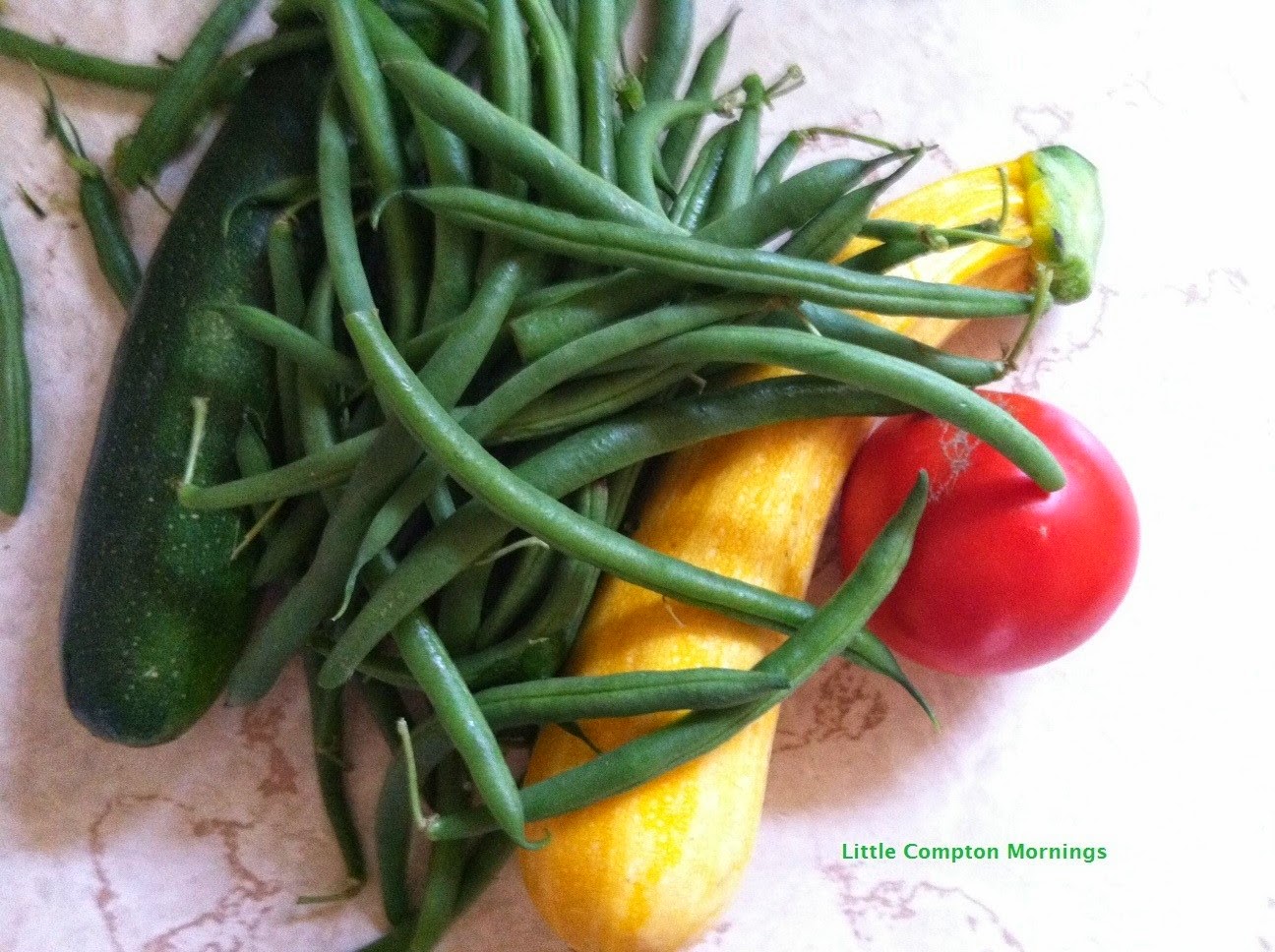
Coll Walker had no corn (we looked for the corn flag, a sign of victory if there ever was one, in vain—the second time in history that there was, yikes, no corn on the 4th), but he did have beautiful slim beans, bushy basil, and truly giant lettuces (there’s always someone who thrives on the chilly weather). Young Farm, however, managed to pick a small amount of corn, and I snagged a few ears. I can be a creature of habit on holidays, but decided to forgo the potato salad in honor of these determined vegetables. Corn and beans are starchy sisters.

And I made a home version of the Newport Creamery burger—a relatively thin burger, grilled, and immediately placed between two buttered pieces of lightly toasted white bread, with tomato (also Coll’s) and lettuce, mayo and ketchup, and a generous amount of salt and paper. The toast absorbs some of the burger juices, and it is all very tasty; toast should be very light (lighter than in the photo) so the bread won't break on cutting. Times have changed—Newport Creamery used to make all their burgers this way—but thankfully, still have one on the menu.

Everything here in Rhode Island is so green, in stark contrast to the desert I just left. The air smells of grass and the sea, and the humidity (100% a few days ago!) was a welcome wave over my parched skin when I first landed. But I am settling back in, I guess: it's getting a little too humid even for me. Off to the beach!

Summer Veggies with Sour Cream

Long before recycling, waste not, want not New Englanders put sour dairy products to good use. We love our sour milk and sour cream, and of course, our buttermilk. All contribute to tender and tangy baking products. But sour cream, like plain heavy cream, does amazing quick duty as a sauce—for noodles and meats, and also for vegetables. This is a very New England side dish. Adjust according to whatever quantities you have on hand. Serves 2.
 
½ lb fresh new green beans
2 ears fresh-picked corn, shucked
1 T unsalted butter
2-3 T sour cream
Salt
Pepper
1 large scallion, white and green parts, sliced
2-3 big leaves fresh basil, chiffonade

Break the stem ends from the beans and cut the corn off the cob with a sharp knife. Bring a pot of water to the boil; drop in the beans and a little salt, and cook for about 3 minutes; add the corn and cook for another minute. Drain.


Melt the butter in a sauté pan and add the beans and corn, tossing to coat and heat through. Add the scallions and toss for a minute or so over low heat—don’t brown anything. Add the sour cream, salt, and pepper, and stir for another minute or so. Add the basil, toss once more, and taste for seasoning. Remove from the heat and serve immediately. If you make it a little ahead, add up to another T of sour cream when reheating. You could add some chopped tomato if you wish.


Friday, June 7, 2013

Happy Doughnut Day! Celebrate with Tomatoes


OK, tomatoes have absolutely nothing to do with doughnuts—although I could imagine a tomato-infused cake doughnut, covered in cinnamon 
sugar. . . . I just couldn’t let this important day go by without mention, despite the fact that the most carb-loaded thing I am eating is a couple of sweet vegetables.  I did have two doughnuts from a local doughnut shop this week on my way to Phoenix—one must get them when one can—so it is not as if I am being virtuous or anything. And I will make doughnuts for the blog this summer.  But for doughnut day today:  tomatoes.

It is hot—nearly 5:00 p.m. and still 107F—and I am tired, tired, tired.  This combination means, in no uncertain terms, no cooking.  Fortunately, I have some rather nice heirloom tomatoes from our rather nice Farmers Market. I also had a few local carrots. So I made this little sweet salad.  It seemed to want an old-fashioned dressing, and just a breath of  it, so I stuck with corn oil, cider vinegar, salt (no pepper), and one of my favorite ingredients, ground caraway seed. With everything fresh and local, including the onion, it makes for a tasty light supper accompanied by another hot-weather essential, Campari and orange with a splash of soda. Followed by a doughnut, if you are lucky enough to have one on hand.


THT (too hot and tired) Tomato Salad

This isn’t really a recipe so much as a list of things to toss together. Serves 1, generously.

2 medium carrots, finely shredded
1 ripe heirloom tomato of your choice (this is a German Stripe), roughly sliced vertically
1 very thin slice onion, halved
1 T corn oil
1-1 ½ tea cider vinegar
Salt to taste
Big pinch—maybe ½ tea—ground caraway seed


Set the tomato aside. Mix the rest of the ingredients and let stand 15 minutes or so, then toss in the tomato and correct for seasoning. Resist the temptation to add a green herb, you’ll spoil it.

Monday, May 27, 2013

Strawberries for Memorial Day: Signs of Summer


I feel guilty talking about summer while it has rained back East for most of this iconic holiday weekend. I know it’s been a cool and rainy spring after a famously brutal winter on the East Coast, and while I am sorry for that, it’s worked out well for me to be staying longer than usual in Tucson again this year, this time to teach an ethics module to the evening and exec MBAs.  Brilliantly sunny, hot, and dry here, of course, but also the fruit is rolling in—apricots, sweet cherries, and beautiful Yuma strawberries. I still can’t get over some of the things they manage to entice out of the desert.

Part of what makes me happy to see the strawberries is that they remind me that it won’t be long ‘til I’m back in the place for which that gorgeous word “summer” must have been created and the standard against which all other summers are measured, New England. I will be back in LC on July 1, which means, of course, a return to this now-mostly-seasonal blog.  I look forward to that, along with everything else precious that summer brings for me—the ocean and the local food, of course, but most of all, seeing my family and my friends. Happy Memorial Day weekend; let summer begin, and be beautiful and bountiful. Surely the hardy people of New England have earned that much. See you soon.

Yuma Express

For some reason I always want to pair strawberries with Campari when it’s hot, as I did with this cocktail a few years ago soon after arriving in LC. Here’s another one, served with a spoon.  Serves 1.

1 oz Gran Marnier (or ½ brandy, ½ orange liquer)
½ oz freshly squeezed lemon juice
3-4 perfect strawberries, cored and sliced

1 oz Campari
1 oz  Plymouth Gin

Macerate the strawberries in the lemon juice and Gran Marnier for 15-20 minutes. Strain the liquid into a cocktail shaker and place the strawberries into a martini glass or coupe.

Add the Campari and gin to the shaker, and shake with crushed ice until very cold. Strain into the glass and serve with a silver spoon.


Wednesday, January 2, 2013

Happy New Year—the Popping of Champagne and Popovers


As usual, we ended the year with a nod to tradition, a casual, largely pick-up meal that is as good today as it was in the 1960s—a quasi-steakhouse dinner of London Broil, wedge salad with a ranchy blue-cheese dressing (Maytag, of course), some very exuberant, gigantic popovers (you want lots of bursting things for New Year’s), champagne, and some apple turnovers made of leftovers—leftover puff paste, leftover almond pastry cream from a Pithiviers. And on New Year’s Day for breakfast, we enjoyed the fruits of end-of-year labor:  homemade tamales filled with shredded pork in a rich ancho-cascabel sauce. Next to apple pie, my favorite thing to have for breakfast. And my son’s very favorite.

How could 2013 not be a good year?


Popovers
 
Use your ancient cast iron popover pan unless, like mine, it went missing in one of your moves; an aluminum popover pan; or, better yet, some 6-oz ceramic custard cups. Put your popovers in the oven while your meat is resting. Serves 6.

1 cup flour, sifted
1 cup whole milk
3 T butter
3 eggs
big pinch salt

Preheat oven to 450F (use an oven thermometer), placing the rack in the lower third of the oven. Generously butter the pan or custard cups, placing cups on a sturdy sheet pan.

Whisk the eggs well, then whisk in the milk and melted, mostly cooled butter. Whisk in the sifted flour and the pinch of salt.  You can make this a few hours ahead; it will be like a thick crepe batter.

Place the pan/cups in the hot oven for a minute or two, then give the batter another stir and pour it in:  do not fill more than a scant 2/3. Bake for 20-30 minutes until huge, dry, and very brown. Do not open the oven while baking!

Serve immediately with lots of soft plain or flavored (e.g., fruit puree, herbs) butter. They will not be quite the same, but you can store any leftovers (ha) in a plastic bag, then reheat in the toaster oven until they have crisped up.


Wednesday, December 26, 2012

Chestnuts Roasting: Merry Christmas!


Surprise!  It’s Christmas, I’m not busy, and in our house it’s all about the food, so naturally I thought of you. This will be brief, but loaded with butter and wine.

Christmas Eve is when we have our big dinner; even for the seasonally small family of me and my son out here in Tucson, it is big, probably too much so. But as Bob Cratchit said, it’s only once a year.

So what did we have?  A number of years ago my son and I shifted away from our usual very English Prime Rib roast, Yorkshire pudding, creamed onions, pies, plum pudding, etc., etc. (very good, mind) to doing something different every year. Last year was one of our all-time great dinners, themed around my first year in the Southwest (and thank you, Bobby Flay, for inspiration). A simple dinner in my son’s tiny New York apartment in 2010 was another.  Generally, the meal does still center around beef, though. But this year I got a text from my son a few weeks ago asking, “Can we have rack of lamb for Christmas?”  Sure, why not?  So after talking options for approach—Southwest again, Middle Eastern, French—we settled on the classic: French.

Here’s the four-course menu—served with French wines (a white burgundy and a good Haut-Medoc), with a Warre 1994 vintage port with our dessert—and a recipe for the soup, a favorite of mine. Jordan really liked the ice cream:

Chestnut Soup with Herbed Puff Pastry Twists

Salad of red leaf, radicchio, fennel, and leek with maple-pomegranate vinaigrette

Rack of Lamb Persillade with Fig Sauce
Duchesse Potatoes
Glazed Onions
Haricots vertes  with hazelnut butter and thyme

Coconut-ginger ice cream with truffles and cookies


Happy Holidays, and happy eating, to all.


Chestnut Soup

This is a delicious and somewhat luxurious soup, suited to the season.  You can make it ahead; add the cream when you reheat if you do. Serves 6-8 (6 rim soup, or 1-cup, portions).


        3 tablespoons unsalted butter
        1/2 cup each finely chopped celery, carrot, and onion
        A few sprigs flat-leaf parsley
        3-4  whole cloves
        1 large dried bay leaf--make sure it is new
        6 cups chicken stock, on the light side
        3 cups cooked whole chestnuts, peeled and crumbled; you can do them fresh, or buy jarred or vacuum-
              packed
        1/4 cup tawny port or Madeira 
        1/4 cup heavy cream
        1/4 teaspoon black pepper and a little salt

        Fennel tops or chopped parsley for garnish

      Make a bouquet garni: Tie the parsley, cloves, and bay leaf up in a piece of cheesecloth.

Melt the butter in a 3-quart heavy saucepan over low heat, add the chopped celery, carrot, and onion, and cover the vegetables with a buttered round of wax paper, buttered side down. Cover the pan and sweat the vegetables until soft, about 15 minutes.

Discard the wax paper. Add the stock and bouquet garni to the pan.  Bring to a boil, then reduce the heat and simmer, covered, 20 minutes. Add chestnuts (you can crumble them in with your hands at this point) and the port or Madeira. Simmer, covered, for about 3 minutes.

In a large food processor or blender, purée in 3 or 4 batches  until smooth, transferring each batch to a bowl. Place a strainer over a clean 3- to 4-quart saucepan and strain the puréed soup into the pan. Reheat, and add the cream, salt, and pepper, stirring occasionally. Taste for seasoning.

Garnish with the small feathery fronds of fennel or some chopped parsley. You could also float a little round of puff paste or a star-shaped crouton, or a disc of parsley butter.


Sunday, September 2, 2012

Pie: Buttermilk, Blackberries, Birthday


For those of you who are surprised to see a post from me now that school has started and I have even warned of my hibernatory hiatus from these pages, don’t get too excited, or expect me back anytime soon.  I started this post a month ago. My pie—my birthday pie!—went awry.  So I postponed this post until I made it again. I really wanted you to have this simple but superb and unusual recipe. I cannot remember where I got it—possibly from a coworker in California in the 1970s, where I picked up my recipe for shortbread, for black walnut cake, for chiles rellenos and a few others. I’m not really sure, but I am sure that this pie is worth making over when you forget to add the butter. Which is what I did.

I was, of course, talking on the phone, the little rectangle with the rounded corners (we now all know what that means) scrunched between my shoulder and ear. Honestly, I cook and talk on the phone all the time. But now that I think about it, I have had another baking omission while on the phone; years ago I left the sugar out of a cheesecake, which I was making to take to a party. I didn’t realize it until I served and tasted it--and came home to find the sugar measured out on the counter. This time I didn’t realize it until I looked into the oven and saw the top of my pie blown up like a balloon and really dark, almost burned—it is always dark, but this was something else—and saw the melted butter sitting forlorn in its little pot on stove.

Both times, happily enough, the final product was interesting. I am almost tempted to leave the butter out of this pie again—the filling separated, much like an old Pennsylvania German favorite of me, my mother, and grandmother, lemon cake pie (I’ll make it for the blog sometime), and it tasted really good.  Hence the photos of two pies, and two slices of pie. The one with the blackberries is the butterless attempt; the one with raspberries is the “correct” one.

Below is how I started off my post on buttermilk, blueberries, and birthday a month ago, when I was still in LC. What a difference a month makes. Or a stick of melted butter.

********

I do love alliteration. And of course, pie. And berries of all sorts. And dairy. So it all came together last week on my birthday. As a child I always asked for pie on my birthday—apple, to be precise—and now that I make my own birthday desserts, nothing much has changed except for the kind of pie itself. I’m more likely these days, when my favorite local apples are not yet in but we are still enjoying berry season, to make a blueberry or mixed berry pie. This year, not really thinking about making a pie, I picked up a cup of blackberries and on the morning of my birthday I thought, what would this make a nice garnish for? A traditional custard pie, of course. Or a lemon curd tart. But I had buttermilk on hand (as always) and wanted to use it up before I leave LC (sadly, time to think about that). So an old-fashioned buttermilk pie, a tangy riff on a chess pie, seemed a good and practical match for the blackberries.
 
Buttermilk is, of course, not what it used to be; it’s not really the milk from churning butter. It’s more of a constructed product. But it is good in its own way, a kind of light, liquid sour cream.  It is great stuff for dips and salad dressings, for marinating chicken, for making tender cakes. I don’t drink it. But then again, I don’t drink milk either, and never did. Ever.
 
But milk transformed is one of my favorite things, and this is a favorite pie.


Buttermilk Pie

The baking time on this pie will depend greatly on your oven. Watch it, and use your judgment.  It should not be jiggly, but only just firm. Test as you would a custard, by inserting a knife half-way between the center and the edge. Serves 6.

Pastry for a 10” pie plate or 9” deep dish pie plate. You can make an all-butter pastry or make one with 1 ½ c flour, a big pinch of salt, 6 T butter, and 2 T lard or shortening, and cold water to bring it together.

1 c sugar
3 T flour
¼ salt
3 eggs, separated
2 c buttermilk
2 tea pure vanilla
8 oz (1 stick) butter, melted and slightly cooled

Preheat the oven to 425 F.

Line the pie dish with the pastry and chill in the freezer. Mix the sugar, flour, and salt and set aside. In a large bowl, beat the egg yolks and whisk in the dry ingredients. Add the buttermilk, vanilla, and melted butter, whisking til smooth. Beat whites stiff but not dry and fold into the custard mixture, blending well. Pile the filling into the chilled shell. Bake the pie at 425F for about 15 minutes, covering the top with a sheet of foil if it gets too brown; reduce to 325F for another 25-30 minutes, until the pie is golden and a knife inserted midway comes out clean.

Let the pie cool on a rack. I prefer this pie at warm room temperature. Do refrigerate leftovers, but take it out of the refrigerator 20 minutes or so before eating them to take the chill off and get the texture back to the way it should be. Serve plain or with fruit.