 After The Sopranos, everyone knows that the part of New Jersey where I grew up is full of Italians Americans. In fact, Tony Soprano’s psychiatrist had her office in the next town over from where I grew up; his aunt went into a nursing home in the town where I lived when I was a baby; and all kinds of things happened in Newark, where I was born; I pretty much lived my youth in Soprano country.
But I lived in an upper middle class town, and though we were surrounded by Italians my experience with Italian food at the time was limited to the inimitable New Jersey pizza on Friday nights; linguine with clam sauce at the famous Clam Broth House in Hoboken; and the occasional lovely supper of bragiole or lasagna at my friend Maria’s house. Her father, a doctor, used to scold me for putting lots of pepper on my food, claiming that hot food would give me ulcers, and I remember thinking that was a funny thing for a man whose name was Dante to say.
It was not until I arrived in Rhode Island for college that I really began to eat Italian food much the way I used to eat salt bagels or crumb cake at home: pretty much every day. For one thing, it was everywhere; where we had delis, luncheonettes, or Chinese restaurants in New Jersey, Rhode Island had little Italian places serving minestrone, pasta e fagioli, chicken cacciatore, burgers on Italian rolls and oven grinders, all kinds of pasta (baked ziti and stuffed shells were big), and veal parmesan. This was only natural: while New Jersey has the greatest number of Italians, Rhode Island has the largest percentage (New Jersey is third). And while both states are small and densely populated, Rhode Island is so tiny and has so many fewer cultural influences that the presence of Italian Americans is, as we might say here, in your face.
My first Sunday family meal at the house of an Italian friend resulted in my mistaking the lasagna for dinner, only to find it followed by a huge roast. I learned quickly to pace myself, and this same friend kindly gave me some formal preparation for the series of courses one could expect during the holidays, and the expectation that I would have to eat every one, and seconds, too. One year I was invited over for New Year’s. My friend’s mother served a big dish of lentils with a large sausage: the lentils, I was told, signified coins—wealth for the New Year. Lentils are not as convincing a coin as the golden gelt of Hannukah, not even if you try to envision them as tiny copper pennies. And of course gelt seems luckier than legumes to a child or other fancier of chocolate (me, for example). But the combination of lentils with pork was very good, and this first exposure to lentils at age 19 remains a fond introduction, both to the food and the tradition.
Last New Year’s I made a luxurious dish, lobster bisque, but this year lentils and pork seem to suit the simpler times. We could all use a few extra coins, and a little luck. So here is my version of lentils and pork, with a little pasta, too, and sage, in hopes of imparting a little wisdom. There’s something to be said for being sadder but wiser.
Mini Farfalle with Lentils, Pork, and Sage
Light but satisfying, you could serve this as a first course or the main dish. Serves 3-4.
1/2 lb sweet Italian sausage
3 T milk
pinch salt and nutmeg, few twists of the pepper mill
1/2 cup minced carrot (about 1 medium)
2 tea minced garlic
2 T olive oil
1 tea butter
1 tea minced fresh sage
zest of a small lemon
1 1/4 cup cooked lentils (about 1/2 cup dry)
2 cups dried mini farfalle or other small pasta shape
freshly grated parmigiana
additional whole sage leaves for frying (optional)
Peel and mince the carrot and the garlic. Using a grater, zest the peel of the lemon onto a piece of wax paper. Stack 4 or 5 large sage leaves, roll them tightly and chop fine; add them to the lemon zest. If desired, dip the remaining, largest sage leaves in flour, shaking off the excess. In a deep frying pan, place about ½” vegetable oil and heat to about 350-375 F; fry the sage leaves in the oil very briefly, until they crisp. Remove to paper towels.
Wash and pick over the lentils. Bring 3 cups water to a boil; add the lentils, and when the water returns to the boil, reduce the heat to a moderate bubble and cook the lentils, partially covered, until just tender, about 20 minutes. Drain and set aside.
While the lentils are cooking, crumble the sausage into a large frying pan and cook, chopping with the side of a wooden spoon, over medium heat until the meat just loses its color; do not allow it to brown. Add the small amount of salt, pepper, and nutmeg as it cooks, and then the milk, continuing to cook until the milk is absorbed. Remove to a bowl, and clean out the pan.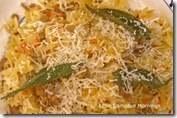
Put the pan back on the stove, add 1 T olive oil, and heat over moderate heat. Add the carrots and cook slowly for about 2-3 minutes without browning. Set aside.
Cook the pasta in boiling, salted water for about 6 minutes; drain, reserving about 1/2 cup of the cooking water. Return the frying pan with the carrots to the stove, add the remaining T of olive oil and 1 tea butter over moderate heat, then add the garlic, sautéing for a minute. Add the cooked sausage, 1 cup of lentils, and the pasta; toss, adding in a little of the reserved pasta water. Stir in the lemon zest and sage.
Serve, sprinkling over some of the remaining 1/4 cup of lentils, and garnish with freshly grated parm and, if desired, fried sage leaves.


 1 ½ T lard


