

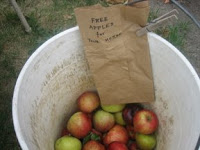

While the first apples always show up in August, after Labor Day the apples in all their variety begin to dominate the farm stands, making a show somewhere between the tomatoes and the pumpkins. I’ve previously admitted my
preference for old apple varieties, and tend to snub more modern varieties. This is both a considered choice and completely easy to do when my local Fruit Lady, as I call her, has old-fashioned favorites like Jonathans, Macs, Pippins, and the wonderful Spencer on hand. And, to my surprise, Gravensteins, that prize pie apple: apparently, some years she misses their peak picking time, which is difficult to judge (as it is for all apples). Thankfully, this year she caught them in time, and they were out on the stand for a week or so. All of her apples were packed in 3-lb bags for a dollar. Hard to resist, so I buy them all.
I have been thinking about what makes the Gravenstein so special for pies, and I think it is the Goldilocks phenomenon. Everything about its taste and texture is just right. It is not too hard, not too soft, but nicely crisp and medium grained. It has a true apple taste, but it’s neither too sweet nor too tart nor sour. It cooks up appropriately soft but never mushy, and sugar brings out its round apple flavor. It’s nice to eat, but it truly finds its calling in pie. Sitting alongside the last-gasp-of-summer raspberries, the most intensely flavorful yet, a Gravenstein apple raspberry pie is a must-make.

Apple picking is a pleasant thing to do on a fall weekend; if you have children, it also provides a concrete lesson in where our food comes from, and the experience of the genuine spouting juiciness and crisp, non-puckery taste of a fresh apple that is ready to be picked. There are orchards all over New England within short drives of every Eastern city; call or go online to see what varieties are grown and ready to pick—and, of course, which ones offer cider and doughnuts as well. In Rhode Island, there are lots of choices nearby:
http://www.dem.ri.gov/programs/bnatres/agricult/orchlst.htm. Your local supermarket, if its customers are picky, may hold some surprises, too. At mine, several truly old varieties are on offer, including the yellow Hudson Golden Gem (a crisp russet originally discovered growing wild

in Oregon), the streaked Reine de Reinette (“King of Pippins,” an 18
th century small but complex apple that originated in Holland), the Cox Orange Pippin (a venerated English dessert apple), and the rough, green, 300-year-young Ashmead’s Kernel. Such apples don’t have the airbrushed American Amazonian mannequin looks of modern hybrids, but a more modest, diminutive country-girl appeal. And they taste as wonderful as their names.
Macs are a favorite for applesauce—and contrary to popular opinion, they make a great, if somewhat soft, apple pie as well; just watch the sugar (true for any pie, but especially here). I love applesauce as a side dish and “dipping sauce” for pork chops, alone for a simple dessert, and stirred into plain Greek yogurt or oatmeal. Applesauce can also be substituted for as much as half the fat in baked goods such as homey cakes and muffins, usually as a substitute for the butter or oil, but also for eggs. If you are interested in cutting fat, this is worth experimenting with, starting off slowly (e.g., substituting applesauce for ¼ or 1/3 the fat) to see what sort changes in taste and texture it produces. Sometimes, the difference is minimal or undetectable.
Below is a recipe for applesauce, and an applesauce cake made with it. Your applesauce can also be further cooked down, with brown sugar and spices, to make apple butter.
Applesauce

You will yield about a quart of applesauce for every three pounds of apples. The type of apple you use affects not only taste but also texture and color. I prefer Macintosh. Good applesauce made from fresh apples should be naturally sweet, have a little color, and have a creamy, smooth-grained, almost pudding-y texture. Macs deliver on all counts. You can also combine apples with other fruits, such as raspberries (very nice), cranberries, or pears; adjust sugar accordingly.
3 lbs apples, preferably Macs
½ cup water
2-3 T light brown sugar (optional)
¼ tea cinnamon (optional)
Cut the apples in half if small, in quarters if large. Place in a large pan with ½ cup water; cover, and bring to a boil. Boil until soft, about 10 minutes, checking (and listening) to be sure the water doesn’t boil away, which would scorch your fruit. This is unlikely, as juicy apples throw water as they cook—but it has happened to me when I wasn’t paying attention.

Place a food mill over a medium size bowl and spoon in the cooked mush; you can do this amount in about two batches. Puree, pressing down and reversing the crank frequently; scrape the bottom with a spoon frequently as well.
Taste the sauce; it will usually be sweet enough that added sugar is not necessary. I like a little though, and also a little cinnamon, added while the sauce is still warm. Let cool before refrigerating or freezing.
Holiday Applesauce Cake
An applesauce cake is essentially a very moist spice cake. This one of mine, with cranberries, chocolate, nuts, and a shiny glaze, is a good keeping cake to have on hand for crowds at the holidays, and can be baked in small pans for giving away. To make a large cake, use a tube pan. I sometimes frost this with a thin layer of caramel icing, but I think I like it best with a chocolate glaze. Since buying Carol Walter’s book
Great Cakes in the early 1990s, I have used her version, but without the rum and with a full teaspoon of vanilla; the recipe is now online at
http://www.carolewalter.com/quick_chocolate_glaze.htm. As always, use the freshest, highest-quality spices available for your baking, and grind your own nutmeg if possible.
½ cup boiling water
1 tea baking soda
½ cup (1 stick) unsalted butter
1 ¾ cups sugar
1 large brown egg
1 ½ cups applesauce, preferably homemade with as little sugar as possible
2 ¼ cups a-p flour
½ tea salt
2 tea baking powder
½ tea cinnamon
¼ tea cloves
¼ tea allspice
½ tea cardamom
1/8 tea nutmeg
2/3 cup fresh cranberries (frozen are all right)
1/3 cup walnuts or pecans, broken by hand into pieces
¼ cup (about 1 ½ oz) chopped semisweet chocolate
Optional: confectioner’s sugar for dusting, or chocolate glaze, or caramel or other icing of your choice
Preheat oven to 350 F. Butter and flour a tube pan. Combine the boiling water and baking soda and set aside to cool. Combine the flour with the salt and spices and set aside.
In a large bowl of an electric mixer, cream the butter and sugar on high. Reduce speed to medium; add the egg and blend. Reduce to low and add the applesauce; the mixture will look curdled—OK. Scrape down with a rubber spatula as you go.
On low speed, gradually add the flour/spice mixture alternately with the soda water, beginning and ending with the dry ingredients. Fold in the cranberries, nuts, and chocolate.
Pour the batter into the prepared pan; holding the pan firmly on the counter, rotate it back and forth for a minute to even the batter. Bake for about 1 hour, or until it tests dry in the center with a fine wooden skewer. Do not undercook. Cool on a rack for 10 minutes; remove the cake on the center piece and cool until just warm. Turn it out on the rack, and turn it face up onto the rack; if you are glazing, place it on a cardboard round if you have one. Dust with confectioner’s sugar, or glaze; let the glaze set for about 10 minutes or until cool and dry, then transfer the cake to a plate or cake stand with a large spatula.


