Saturday, August 23, 2014
Locovore: Loco for Local
No, not a typo. I recently had friends over for the last
largish meal I made before leaving Rhode Island to return to my desert home for
the academic year, and realized that, without even trying, every single thing
we ate was locally produced. On an island
(Conanicut, otherwise known as Jamestown).
Don’t you just love that?
It was hot in the morning, and the forecast was for
thunderstorms. My friends don’t care for the heat. And my cottage is little
and, of course, doesn’t have air conditioning. So I decided to make a dinner
that I could cook before the rain and serve at room temperature. What a great
excuse: that’s actually one of my favorite ways to eat.
My friend Wayne (source of the mussels)
had called me up and offered me some fresh-caught Bluefin tuna “head steaks”; I
learned that this was the meat right behind the head that was cut off in
preparing a giant tuna to be sold. My friends may not like the heat, but I knew
they liked tuna, so of course I said yes.
Wayne swung off the bridge to drop me the fish on his way out to another
fish-spotting gig.
A Jamestown Dinner
Dinner for Friends on a Muggy Day Threatening
Thunderstorms
Tuna Tartare on potato chips
Figs with goat cheese sweetened with honey and fresh thyme
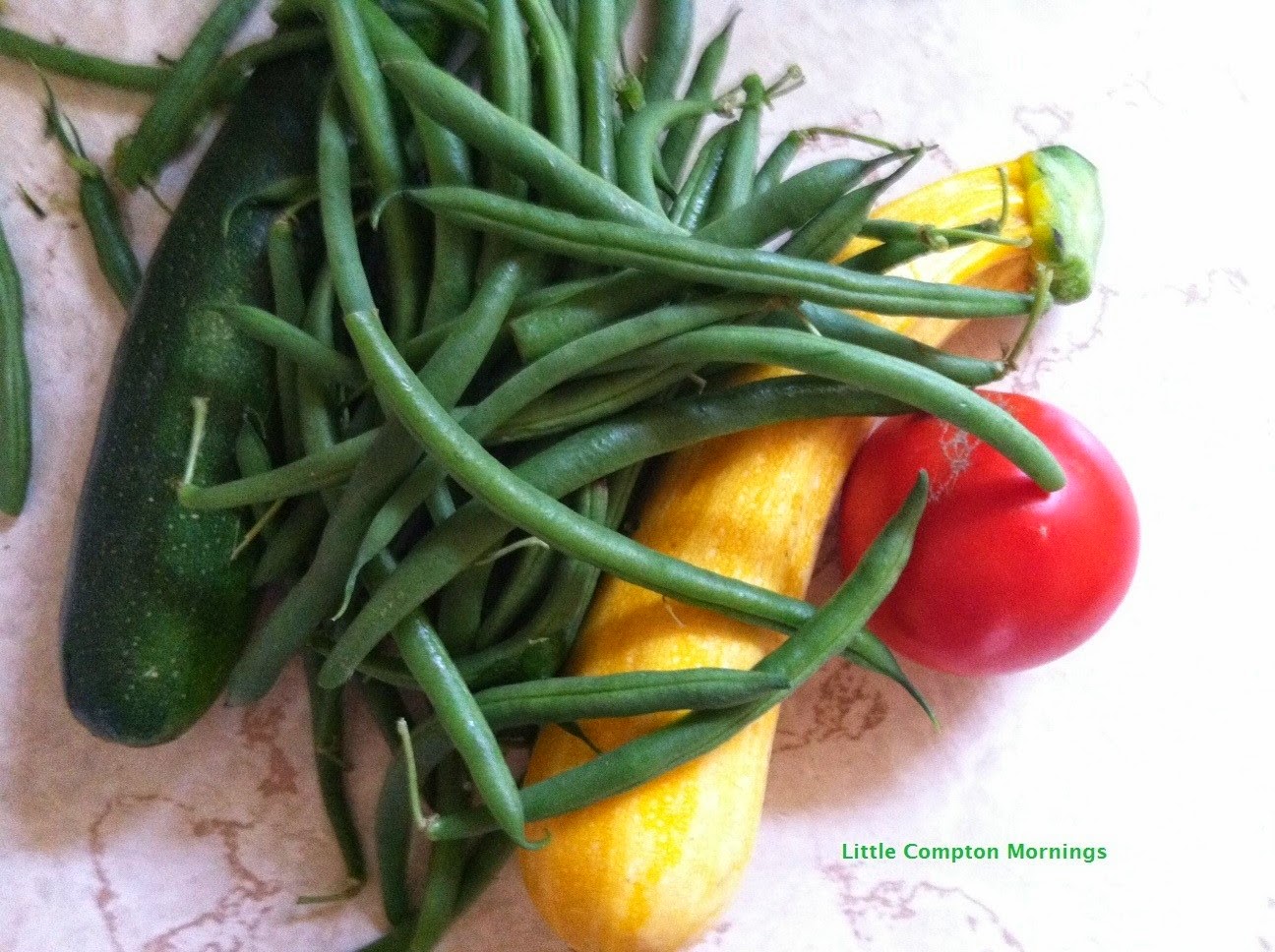
Green beans marinated with olive oil and fresh oregano
Tomato and mozzarella (from Narragansett Creamery) salad
Ciabatta from Venda Ravioli
Organic Blueberries and Peaches with Maple Sour Cream
Tuesday, August 12, 2014
Strawberries: The Real Thing

Well, this is a little out of summer sequence, because this
is the first local product I bought when I arrived here in June, and this jam
is the first thing I made. How could I forget that precious item that that I eat
only in their native habitat in season—strawberries (not counting tomatoes, of
course)—particularly when they are scarce to nonexistent in Tucson, unless it
is the strawberries brought in from Yuma?
Which doesn’t happen much.
The strawberries were amazing this year: a gift after a
cruel winter. It is a ritual for me to make a small
batch of jam with the first ones I get, and this summer was no different. I
always makes something a little different—although strawberry-vanilla is a
perennial favorite—and since I had just planted a little container herb garden,
I decided to take advantage of the fact that I had a nice lot of true
peppermint on hand.
I suppose that my strawberry jams are really more like preserves. I leave smaller berries whole, and only cut larger ones in half. And of course, I like my jams cooked just long enough so that they have jelled but are still fluid. This takes a lot of practice—I am anti-commercial-pectin, as you may know—but is well worth the effort for a perfect, versatile product.
Strawberry-Mint Jam
I just throw the mint in whole and fish it out after the jam
is done. Use as much or as little as you like. Makes a little over a pint.
1 pint ripe local strawberries
1 ¾ cups sugar
Pinch salt1 ¾ cups sugar
3 or 4 nice big sprigs of peppermint, left whole
Juice of half a lemon, and the rind
Wipe strawberries with a paper towel, hull, and cut the
large ones in half. Put everything into a minimum 2-qt saucepan and bring to a
boil over medium-high heat, stirring gently to dissolve the sugar. Reduce the
heat somewhat, but keeping it at a low boil, and cook, skimming, until it is as
you like it, testing by your preferred methods or temperature (about 220F at
sea level). Ladle into jars, and freeze
one for a treat during the cold winter months.Friday, July 18, 2014
Apple Cider Vinegar: What Grandma, and Hippocrates, Knew
I am never without cider vinegar. Because if I run out, I immediately need it again before I can even get to the store (word to the wise: Buy at least a half-gallon; it lasts). Cider vinegar is that versatile, and that, in my opinion, nonsubstitutable. If that is a word. You may sometimes see distilled white vinegar suggested as an alternative, but no, too sharp. Apple cider vinegar is sweeter and more mellow—I’d go for my white balsamic, to which I am equally devoted, before that, at least for dressings and maybe some chutneys. But really, just have it on hand. It’s dirt cheap and always produces just the right subtle result.
Of course we cook and preserve with it. But it has been a
kitchen and apothecary staple for many other purposes since ancient times—as a
refreshing and healthful tonic (making a come-back today, bottled like water
and sold, like water, at high prices to the susceptible); an excellent cleaning
product and stain remover; a cool skin astringent; a rinse for squeaky clean
hair; a pesticide; a disinfectant; a de-scaler; a weight-loss aid--and Colonial
bakers understood that a little bit worked a tender magic on pie crust and
bread, and that it was just as at home in a homey dessert as in a jar of
pickles, as this unusual—and unusually good--roly-poly
attests.
Vinegar Roly-Poly With Corn
You can’t get more old-fashioned than my version of this old
idea: truly, something my Pennsylvania German grandmother would have made, even
with what turned out to be a somewhat inspired use, if I do say so myself, of Coll’s
corn. I do sometimes think Grandma’s spirit lives on in me. Serves 8.
For the syrup
¾ cider vinegar
1 ½ c water
1 cup sugar
2 tea cinnamon
For the dough
2 c sifted a-p flour
1 T bp
1 tea salt
1/3 cup (5 T) lard or, if you must, Crisco
¾ whole milk
For the filling
1 ear fresh corn
4 T butter, divided
2 tea cinnamon
Preheat the oven to 375 F. Lightly grease a 9” round pan or
pie plate and set aside.
Combine the vinegar, water, 1 c of sugar, and 2 tea cinnamon
in small pan over low heat til sugar dissolves. Raise the heat to medium, and
reduce by half or so to a light syrup, about 20-30 minutes. Set aside.
While making the syrup, shuck the corn and cut the kernels
off; do not scrape the ear yet, but set it and the corn aside.
In a medium bowl, mix the flour, bp, and salt. Cut in the lard
or shortening. Scrape the milk from the reserved ear into the mixture, add the
whole mile, and stir to make a soft dough. Lightly flour the counter or a board
and roll the dough into a rectangle ¼” thick, about 9 x 10. Sprinkle the
remaining ¼ sugar and 2 tea cinnamon over the reserved corn kernels. Sprinkle a
bit of extra sugar over the dough, then distribute sugar-spiced corn over it. Dot with 2 T butter.
Roll the dough gently from the longer side and cut the dough
crosswise 1” thick, first trimming each end by about ½”. Place the slices cut
side up, close together, in the pan. Dot with the remaining butter. Pour over
all the hot vinegar mixture. I recommend
placing on a nonstick sheet pan or enameled broiler pan. Bake 30-40 min
at 375, until lightly golden and dry to the touch, with no apparent liquid: a
sauce will have formed on the bottom of the pinwheels. Let sit for just a minute, then serve very warm,
with some pan sauce and then some heavy cream spooned over, as a dessert or breakfast treat.
Note: Don’t be
tempted to cut back too much on the 4 tea of cinnamon. It’s a lot, but not too
much; it transforms quite a bit in the syrup. If you cut it down, cut a
teaspoon from the sugar mixture that goes inside the dough.
Labels:
cider vinegar,
cinnamon,
corn,
Jane Robbins,
Little Compton Mornings,
roly-poly
Thursday, July 10, 2014
Yours for the Taking: Mussels
Gathering shellfish in New England—clams of all sizes,
mussels, scallops, oysters—is as close as you can get to a free lunch,
especially when someone else does the gathering and gives you the benefit of
their labor. I received such a gift the other day. My friend Wayne—a fish
spotter and aerial fish photographer—called
to ask if I’d like one of the three fish buckets’ full of mussels he had picked
up after getting off a pilot boat early one morning in Snug Harbor to find them
lying there at low tide, ready to scoop up. Big ones, too. Did I want some? Of
course I did: wild shellfish is increasingly hard to get. A bucket was way too much, but I did fill two
bowls to the brim and headed home, thinking what to make.
That was relatively easy.
While French in origin, the mussel soup Billi Bi shares our New England
sensibility of simple elegance, and our fondness for mixing shellfish with
dairy—especially cream. It has long
been at home here, although I must say I don’t see it on menus as much as I
used to. Mussels make a good chowder,
good salads, and of course the simplest preparation of all, Moules Marinière—but
Billi Bi seemed the right thing to do with this large windfall.
The soup is quick to make once the mussels are cleaned, but
cleaning does take a little time. They must be debearded, scrubbed, and checked
to ensure that they are alive. Here is the method:
To clean and store mussels
Use your mussels as soon as possible. If you must store them
for a few hours before cooking, put them into a bowl, cover with a damp towel, and
store in the coldest part of the refrigerator.
You can scrub them, but do not debeard until you are ready to cook
them. When ready to use:
Put the mussels in the sink and rinse with water; do not let
them sit in water, however. Sort through the mussels and discard any that are
not alive. Mussels should be shut tight. If the shell is open, tap the mussel
on the counter firmly near the mid-point; if it is alive, it will close up. A
mussel whose shell flaps open and closed when you press it between your thumb
and forefinger is dead.
Debeard the mussel. Hold the mussel, hinge down or toward
you, in one hand; with a paper towel in the other hand, grasp the fibrous byssus,
or “beard,” and pull toward the hinge firmly to remove. Do not pull up. Discard the beard. Debeard mussels as close to when
you plan to cook them as possible
Scrub the mussels all over; I like to use one of those stainless
scouring pads. Remove any small
barnacles with the inside blade of a pair of scissors or the back of a paring
knife.
Storing cooked mussels
Mussels can be removed from their shells and stored in the
refrigerator for a few days or in the freezer for a couple of months, ready to
be used in salads or pasta dishes. Store in an airtight container with a little
broth from the cooking or vinaigrette.
Billi Bi
You will see that the first step to making this soup is
similar to making Moules Marinière. If you want to make this several hours
ahead to serve hot, leave out some of the cream and the egg yolk, and then
finish it just before serving. Billi Bi can also be served cold; make it a few
hours ahead and chill. Serves 8.
2 cups dry white wine
2-3 shallot cloves, peeled and sliced
1 large sweet onion, peeled and sliced
2 large ribs celery, slit in half and roughly chopped
4 T unsalted butter
4 sprigs parsley
2 sprigs thyme (or 1 tea dried)
Pinch of cayenne pepper
Freshly ground pepper
4-5 lb medium-large mussels, preferably wild
4 cups heavy cream
2 egg yolks, lightly beaten
Put the wine and all the vegetables, herbs, and seasonings
in a 6-qt dutch oven or small stockpot. Put the mussels on top. Cover and bring
to a boil; then reduce and, with the lid slightly ajar, simmer for about 10
minutes; the mussels should be open but still look moist. Strain through a fine
strainer or cheesecloth into a large bowl or directly into a 3-4 qt
saucepan. Taste for salt; wild mussels
in particular can be salty, but you can add a little salt at this point if you
think it needs it. Set the broth aside. Remove the mussels from their shells
and reserve for garnishing the soup. You could remove just some of them, and
serve the rest in their shell.
When ready to finish the soup, bring the reserved broth to a
boil. Over medium heat, add the heavy cream and let it come to a gentle boil,
whisking. Ladle a cup or so of the soup into the egg yolks, whisking as you go.
Slide the pan off the burner and whisk the egg yolk liason briskly back into
the soup. Taste for seasoning. Keep it warm, but do not allow to boil again. It
should be a lovely creamy yellow-white color.
To serve, ladle into small cups or rim soups. Garnish with
two or three mussels (they will sink into the soup) and a sprinkling of very
finely chopped parsley.
Don’t like mussels or have someone who doesn’t? Not to
worry. This delicate cream soup is something almost everyone loves—just leave
out the mussel garnish.
Friday, July 4, 2014
Radicalism Revisited: Small Batch Pepper Relish
![]() |
So on this 4th, let’s remember that change is
good. Things were never meant to be the same, and time does not rewind. This, of course, goes for our rules of
preserving, about as outdated as can be. So I refer you to one of my oldest
posts, written on the 4th back in 2007, on radical
preserving. Need a pepper relish for
today’s iconic and essential hotdogs?
Make it now, eat it later. Only what you need. Only what you want.
And speaking of the value of change for the future. It is
pouring here in New England today, as a weakening Hurricane Arthur approaches.
Everyone has moved their celebrations to tomorrow: the weekend is supposed to
be beautiful. And we will celebrate our independence to celebrate when and how we
want. With hamburgers, hot dogs, and potato salad—and this relish.
A Little Red Pepper Relish
One pepper, one onion, one hour. A singularly radical relish. Here, too, is a variation
from several years ago. Makes ½ pt.
1 medium red pepper, cleaned and diced
1 medium sweet onion, peeled and diced
½ c apple cider vinegar
1/3-scant ½ cup sugar
2 T maple syrup
1 tea coarse sea salt or kosher salt
Optional: For hot
relish, add a small chopped fresh chile such as a serrano to the
vegetables, or a ¼ teaspoon of dried red pepper flakes to the sugar/vinegar
mixture.
Bring about 4 cups of water to a boil in a 3-qt and drop in
the vegetables. Remove from the heat and let sit 5 minutes. Drain and repeat.
Let the veggies drain for at least a half-hour.
Combine the sugar, vinegar, salt, and maple syrup in the pot
and bring to a slow boil, stirring, until sugar is dissolved. Add the drained
vegetables, and cook at a medium bubble for 15-20 minutes, stirring
occasionally, until a wooden spoon dragged through the center leaves a clear
path for a few seconds. Ladle into a clean 8-oz jar.
Tuesday, July 1, 2014
Local in Rhode Island: Italian Rules
So for my son’s birthday I made a typical Rhode Island
Italian meal. I was going to do the squid, but forgot to get it on my shopping
trip, so for appetizers we had some Italian cheeses, some perfect melon and
imported San Daniele prosciutto di Parma, and some wild shrimp with an
orange-mustard-tarragon sauce. And Americanos for drinks. For the main course, for
a special dinner in Rhode Island Italian world you want to start with some
giant veal chops from Venda Ravioli
(Costantino’s). I cooked them on the grill and served them with a little
roasted garlic and sage butter, accompanied by grilled veggies (red peppers,
zucchini, yellow crookneck, and radicchio) with reduced balsamic and thyme, and
a very Rhode Island jonnycake
polenta.
A nice Fossacolle Rosso de Montalcino. Had to buy dessert (horrors) because the
cooking equipment I’d ordered to make a cake was inadvertently shipped to
Arizona. But it was good.
So I just said that some things never change, but, you know,
some do. I am not in Little Compton this summer. I’m on Conanicut
Island—Jamestown—in the middle of Narragansett Bay between Newport and the
mainland, or as we say here, between West and East Bay. As master of the
neither here nor there, the generally at sea, I am perhaps unsurprisingly right
at home. It is, after all, almost as old a Rhode Island settlement as Little
Compton, and still Newport County. A short sail away.
Rhode Island
Jonnycake Pan-fried Polenta
I used Kenyon’s meal for this; you can use any of our RI
stoneground white flint cornmeals. You can, of course, serve the cooked
polenta soft, with butter and parm, or tomato sauce and/or some sausage and
mushrooms. Serves 4.
4 cups water, approx.
2 T butter
2 tea salt
Freshly ground pepper
In a 3-qt saucepan (nonstick is useful if you have one),
whisk about 1 ½ cups water into the cornmeal, then whisk in the additional 2 ½
c water. Bring the mixture to a boil over medium-high heat, stirring fairly
continuously. It will begin to thicken rather quickly. Be careful not to
splatter yourself as it reaches a boil. Stir in the salt, butter, and pepper. Reduce
the heat and let it simmer/heave for about 45 minutes; it will have the
consistency of mashed potatoes, and pull from the bottom of the pan.
If you plan to pan-fry it, pour the polenta into an
ungreased glass pie plate or 8” square pan. Let stand for about ten minutes,
then cover with plastic wrap and refrigerate until firm—a few hours, or
overnight. Cut into wedges, squares, or diamonds, dredge lightly in seasoned flour,
and fry in a little olive oil or butter or olive oil until nicely golden. Serve
immediately.
Labels:
Jamestown,
jonnycake cornmeal,
Little Compton,
polenta,
veal chops
Sunday, May 18, 2014
Artichokes: Grilling the Globe
Since then—and it has been a very long time—I have largely
bought artichokes when they looked particularly good, and were at a
particularly good price, in the market. This was not all that often. When I
lived in Nashville,
I discovered a grilled artichoke at Bricktop’s that became one
of my mainstays in that otherwise food-bereft and regressive Deep South town. Bricktop’s
is a chain, which tells you something about the food scene in Nashville at the
time, but it was a good, reliable place, and it and its grilled artichoke
became something of a comfort to me during my years there. I would often stop
in after teaching late—until 7:30 p.m.—on a Thursday night, the end of my
teaching week, and order a grilled artichoke and a glass of red wine. That
grilled artichoke, served with melted butter and remoulade (they have since switched to aioli, apparently), remains
for me the gold standard of grilled artichokes.
So of course, I try to make mine taste just the same. While
I don’t have their superhot restaurant grill, I can come pretty close. Here is
how to do it, using globe artichokes purchased for $1.00 each at my local
supermarket. They are a sign or spring. Like the gila monster, who comes out around the same time of year, and has similarly vicious tendencies in its natural state
Grilled Artichokes with
American Remoulade
I like to have an artichoke all to myself, and make a meal
out of it. If following with a steak, half an artichoke per person will do. And
you can dip it into anything creamy mayonnaise-based sauce that suits your
fancy: aioli, lemon mayo, ranch dressing, or this Americanized version (minus capers and cornichons) of
remoulade. Just be sure you make it fresh.
1 artichoke per person
Lemon juice
Flour
Olive oil
Salt and pepper
American Remoulade
1 cup mayonnaise, preferably homemade
1 1/2 T mixed tarragon, parsley, chervil, chive; the
tarragon and parsley are essential
1 T Dijon mustard or more to taste
1 tea minced shallot
Drop or two Tabasco sauce
1-2 tea lemon juice to thin
Salt and pepper
Lemon wedges
Melted butter
Trim the stems of large artichokes to about ½” and remove
any loose lower leaves. Using a sharp knife, square off the top of the
artichoke, cutting across the top spines, and then, using sharp kitchen shears,
cut off the tops of the other leaves, removing all spines. Put a few inches of water in a 3-4 qt saucepan
with a lid, add a little lemon juice and a sprinkling of flour, and place in
the artichokes, stems down, so the artichokes are touching and remain upright.
Bring to a boil, covered, then reduce the heat and steam until you can pierce
through the center straight to the bottom with a sharp knife, about 15-20
minutes. Do not overcook.
Remove, allow to cool, then cut in half vertically. With a
spoon, remove and discard the fuzzy choke. Combine all the remoulade
ingredients to taste and set aside.
Brush the artichokes with olive oil seasoned with salt and
pepper. Grill face-down on a hot grill
for 5 minutes; turn to grill for another
3-5 minutes, until nicely charred. Serve with lemon wedges, the sauce, and some
melted butter or more olive oil mixed with salt and pepper for dipping.
Subscribe to:
Posts (Atom)