 Now that we have our syrup, it seems the time may be right to have a conversation about that touchy subject, the jonnycake. Not a national conversation--jonnycakes, after all, are native to Rhode Island and so the issue is deeply local—but a political football nevertheless.
The crux of the matter is: thick, or thin? An ocean divides those favoring the one over the other. Or rather, a bay: those who favor thick jonnycakes dwell west of Narragansett Bay (and often put an “h” in the spelling), and those who favor thin dwell on my side of the water, east of Narragansett Bay. In fact, the thick are often called “West of Bay” jonnycakes (sometimes called “South County”), and the thin “East of Bay” (sometimes called “Newport”). The Green Line. The Berlin Wall. The Naragansett Bay. There is no construct more political, or arbitrary, than geography.
I am a good neutral party to referee this debate. After all, I’m originally from New Jersey, and come to the subject with no congenital bias. On coming to Rhode Island, I first lived in West Bay—and my first jonnycakes were, of course, thick—but I now live in the thin country of East Bay. I approach the topic with a diplomat’s knowledge and respect for cultural differences of opinion. I have, as you surely know by now, no opinion of my own. I'm perfectly objective.
Definitions are the foundation of legitimate debate, so we’ll start there. A jonnycake is a pan-fried unleavened cake made from 100% stone-ground Rhode Island white flint cornmeal mixed with water (and/or a bit of milk, depending on allegiance) and a little salt. The real thing contains no sugar, no flour, no flavoring, no fat, no egg. It is the most basic, indeed primitive, of breads, its nourishing preparation yet another gift of the Patuxet Indians to the struggling Pilgrims. The unique bittersweet taste of a jonnycake is the taste of history.
We start with the thick side of the controversy because thick jonnycakes are most likely the closest, perhaps nearly identical, to the ones first tasted by the settlers. They are also somewhat easier for the beginner to make. Jonnycakes may be simplicity itself, but cooking them properly takes a lot of trial-and-error practice to obtain a cake that is fully cooked without being burned, and that will remove from the pan without benefit of a chisel and sledge hammer. Not to scare you from trying your hand, just to let you know that, if your initial batch is ruined, you are not the first. Lower the heat, use a heavier pan, and try again.
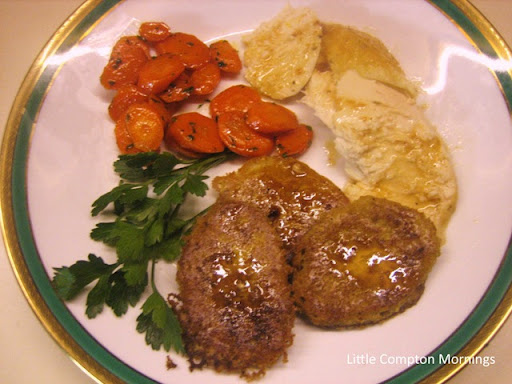
A classic but nearly forgotten way to serve thick West of Narragansett Bay jonnycakes is with roast chicken and gravy. Nowadays most people eat them exclusively as breakfast food, with lots of butter and maple syrup, but they make an admirable substitute for potatoes. In fact, my first taste of jonnycakes was as a side to a chicken dinner. A college boyfriend, the late Manny Read, made them for me, as I of course had never heard of them before arriving at URI. I prepared the chicken and gravy to accompany them (told that this was the proper way to eat them), dubious all the while as to the propriety of putting a sort of pancake alongside a chicken, let alone the palatability of any pancake that was to cook for half an hour. To this day, that meal is a vivid taste and personal memory. I suppose you could say it made me a Rhode Islander.
Back then, chicken and jonnycakes could be found on restaurant dinner menus, particularly in Johnston and other towns in the northwestern part of the state. One of my very old Rhode Island cookbooks even has a recipe for something called “Johnston Spanks,” a kind of deep-fried thick jonnycake, to be served with poultry and meat. I am not so sure you could find this dish in a restaurant anymore. But you can make it at home.
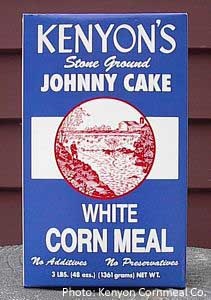
Thick West of Narragansett Jonnycakes
West of Bay, cooks generally use Kenyon’s or Carpenter’s cornmeal for their jonnycakes; note however that Kenyon’s has not used white flint corn for five or more years due to low availability. You can visit Kenyon’s 17th century grist mill, located near University of Rhode Island in Usquepagh, or Carpenter's water-powered, 18th century grist mill in Perryville near Moonstone Beach. There is controversy about cooking time; I have given both timings, which in many ways depends on just how thick you like to make your jonnycakes and how you control your heat. Makes 8-10 thick cakes.
1 cup stone-ground jonnycake cornmeal
1 cup boiling water and more as needed
½ tea salt
Put the cornmeal into a heatproof bowl and warm it in an oven or microwave. Mix the boiling water into the cornmeal and salt to form a mush; let it stand, covered, for a few minutes. Add 1-4 tablespoons more water (some use milk, I do not) to thin, if necessary, to achieve the consistency of light, smooth mashed potatoes that will fall readily from a spoon. Some modern cooks also add a teaspoon of sugar or molasses, but it alters the divine bitter edge of a true jonnycake that is better offset with syrup or a sweet accompaniment such as chutney or glazed vegetable.
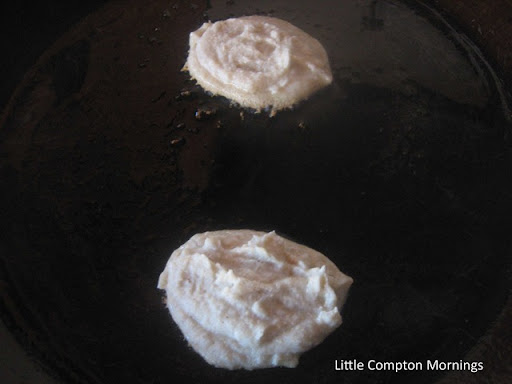
Cooking Option 1
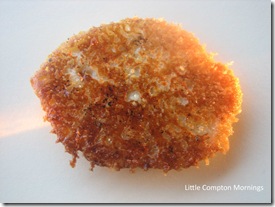
Heat a griddle medium hot and grease generously, preferably with reserved bacon fat or lard. Stir the mush once more, and drop it by tablespoonfuls to make oval cakes about 3 inches long and ½” thick or more. There should be enough fat that the cakes sizzle gently around the edges. Cook, without disturbing or pressing down, 6 minutes; turn, and cook another 6 minutes. They should be brown and somewhat crusty; depending on your heat, they may be ready to turn (easily, without prodding at all) in a minute or so sooner, but jonnycakes need to be cooked through so that the center is not mushy. It is traditional to make and then discard the first (often burned) trial jonnycake, but once you get the hang of it you won’t have to.
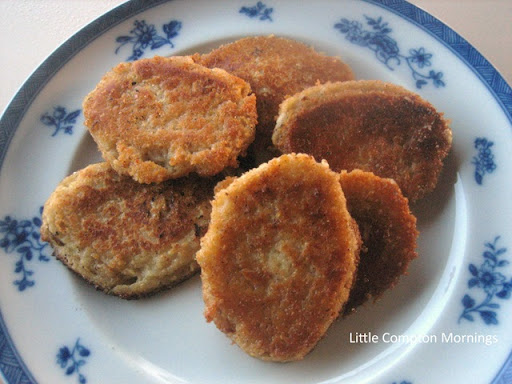
Cooking Option 2
The same except heat your griddle to medium low and cook for 15 minutes each side. This is a more traditional way of cooking them, and is suitable if you like your jonnycakes plump.
As you finish your jonnycakes, put them in a hot oven to puff up a bit and keep warm. Serve with chicken and gravy (or as I do nowadays, pan juices thickened with a little butter), as a base for a sauced dish of meat or seafood, or for breakfast with butter and maple syrup. Maple-glazed carrots are a nice accompaniment to the chicken.